




skip to Main Content
Azole fungicides are used primarily on wheat, corn, and soybeans.

Archived Blog Posts
  • Europe is Growing Organic Production, Will the US Follow Suit?

    Advocates calling for change in US Ag Inc often struggle to point to successful models through which farming and food chains have evolved toward safer and more sustainable production systems. The surest way to largely eliminate the impacts of prenatal pesticide exposure on birth outcomes and children’s development – HHRA’s foundational goals – is converting US farmland to organic production. We are often asked how such change can come about. Convincing answers to this key and important question are few and far between in the US, but some key lessons are emerging from efforts in Europe to expand organic farming and food supply chains. The Cilento organic food bio-district in Italy was established in 2009 and is thought to be the first-ever in the world. Overcoming challenges faced by organic farmers in marketing their produce was a primary driver. Municipal actions expanded demand for organic food and ingredients via public food-purchasing programs. The lure of scenic rural landscapes and strong support from the agrotourism industry for organic food and farming created new market demand. Today, organic farming is thriving in the Cilento district, profit margins have expanded, and enhanced soil health is supporting higher yields at lower costs on many farms. An action by a city council led to the formation of the Södertälje organic food system in east-central Sweden, some 35 kilometers from Stockholm. The goal was to expand the supply of organic products for public food-procurement programs as a way to advance health and environmental quality. The municipality’s Diet Union developed new food products and recipes in the context of a “Diet for a clean Baltic” to promote health and reduce food waste. Restaurants and cafeterias began using smaller plates to cut down on waste, an intervention that has proven to be surprisingly effective. In south-eastern France the mad cow disease outbreak across Europe was the trigger of action leading to the Mouans-Sartoux organic food system. The initial focus was on supplying organic beef to school canteens, coupled with municipal government support for regional sustainable farm research and food education programs. A multi-faceted effort to provide organic food to children led to greater awareness of the diversity of benefits arising from organic farming. New efforts emerged to reach other vulnerable segments of the population with organic food (e.g. the elderly, pregnant women). These three region-based organic food systems in Europe are case studies in a just-published paper by Lilliana Stefanovic (2020), a scientist in the Department of Organic Food Quality and Food Culture at the University of Kessel in Germany. Imagine that. An academic department focused on organic food quality and culture. How long might it take for such a department to take hold at Iowa State University, in the heart of American farm country? The Stefanovic paper addresses how local organic food systems in Europe can contribute in achieving the Sustainable Development Goals (SDG) set forth by the United Nations, and especially SDG 12, “responsible consumption and production.” Her analysis concludes that local and place-based organic food and farming districts can make important contributions in transforming food and farming systems to promote human and animal health, and soil health and environmental quality. Two drivers played key roles in all three case studies: relatively short distances to population centers, and significant support for organic supply chains from public food-procurement programs, and especially those feeding children. And just a few months ago, the Italian government pledged to invest 3 billion euros (about $3 billion US) to convert at least 25% of the country’s farmland to organic systems by 2027. The funds will come from Common Agricultural Policy payments supported in part by a tax on pesticide sales. There are about 16.6 million acres of arable land in Italy. Reaching the 25% organic goal would entail the transition of around 2 million more acres to organic, given that a little over 15% of Italian farmland is already managed organically. If $3 billion in transition payments were spread over 2 million acres, average payments would be around $1,500 per acre. A multi-pronged effort in Italy is planned to simultaneously grow the supply of organic foods and demand for them. Investments will be made in the infrastructure needed to support profitable regional organic food supply chains, while increasing the supply of value-added, premium foods for sale throughout Italy, Europe, and for a few commodities (especially olive oil), the world. Such bold pledges and audacious goals have come and gone in many countries with little concrete and sustained change to show for the resources invested. But perhaps the time is right in Italy for acceleration in the transition to organic farming in light of the many scientific studies showing that organic farming can both slow global warming and render farms more resilient in the face of drought and flooding. What about here in the USA? The USDA has recently pledged to invest $300 million in a new Organic Transition Initiative. This program will provide new funding via many USDA-program channels to encourage the transition of farms to organic production. While a major increase in USDA funding dedicated to expanding organic production, $300 million over several years is a small share of the approximate $20 billion in annual federal spending on farm commodity and crop insurance programs. It is also instructive to compare the $3 billion investment in Italy to reach their goal of 25% of farmland in organic by 2027 to the $300 million investment just announced by USDA. The Italian program, if it actually happens, would provide about $1,500 per acre transitioned to organic. The USDA’s investment of $300 million translates into about $4.30 per acre across the approximate 70 million newly transitioned acres necessary for 25% of the US cropland base to be managed organically. Current disparity in public support for and investment in the transition to organic farming in the US versus Europe arises from vastly different public awareness of the benefits likely to stem from the transition of more farmland to organic production. Many public and private institutions […]

  • HHRA Files Comments in Support of Another Milestone in Quest to End OP Insecticide Use – Big Step for Farmworker-Environmental-Public Health Justice

    By Mark Lipson, HHRA’s Director of Policy and Regulatory Engagement September 25th marked the close of public comments on a historic petition to EPA calling for an end to organophosphate (OP) pesticide applications on food crops. Twelve groups led by the United Farm Workers Foundation and Earthjustice petitioned EPA last November with a compelling summation of the case for ending all remaining uses of OP poisons in the food system. From the 1980s through about 2000 both in the US and globally, organophosphate (OP) insecticides were the most heavily applied family of pesticides used to kill insects. For a half-century the OP chlorpyrifos was by far the most heavily used OP, but use ended in 2020 because of adverse impacts on the neural development of children. Several OPs remain in use today including acephate, diazinon, terbufos, dimethoate, and oxydemeton-methyl. HHRA submitted lengthy comments signed by three of its principals, Dr. Phil Landrigan, Dr. Kathleen Merrigan and HHRA Executive Director Dr. Charles Benbrook. Each of the signers has played important roles in the decades-long fight against the manifold harms caused by OP farm chemicals. Dr. Landrigan led the landmark National Academy of Sciences panel that wrote the 1993 NAS report Pesticides in the Diets of Infants and Children. The importance of that NAS study was summarized in a high-profile comment signed by dozens of prominent doctors and scientists in support of the UFW Petition: “In response to the NRC [of the NAS] 1993 pesticide report that documented the overwhelming scientific evidence on early life susceptibility to pesticides, Congress in 1996 unanimously passed the Food Quality Protection Act (FQPA) —the only federal environmental statute containing explicit provisions for the protection of children.” Yet 25 years later the promise of FQPA is not yet fully realized. The scientists’ letter continues: “In the quarter-century since the enactment of the FQPA, while OP uses have continued to increase at the expense of children whose brains were irreparably impaired, the scientific evidence of neurodevelopmental harm in children from real-world OP exposures has strengthened.” The neurotoxic and developmental harms of OPs fall hardest on farmworkers and their families. As the Petition succinctly states: “The farmworkers who grow our food face the highest exposures and risks from OP pesticides. In addition to exposures through food and drinking water, they are exposed when they apply the pesticides or enter fields that have been sprayed, and they and their families are more likely to be harmed by pesticide drift because they live and go to school near where OP pesticides are sprayed…The science, the law, and principles of environmental justice require EPA to ban OP uses that are unsafe and that harm workers and their families.” The Petition calls for four main actions by EPA impacting the human health assessments and regulation of OP insecticides: EPA must end its unreasonable delay and move expeditiously to protect people from the OPs. EPA must revoke tolerances and cancel registrations for food uses of OPs for which the EPA is unable to determine that there is a “reasonable certainty of no harm” stemming from current levels of OP dietary exposures. EPA must update its OP risk assessments to use a regulatory endpoint that will protect children from neurodevelopmental harm, as well as the impacts of coformulants (i.e. “inert ingredients”) on exposure levels and the toxicity of end-use products. EPA must cancel registrations allowing OP uses that pose significant risk of unreasonable adverse effects on applicators, farmworkers and other people exposed near recently treated fields. HHRA’s comments provide the authors’ perspectives on each of these four actions, and the imperative need for EPA to act on them all. In addition to highlighting the well-established neurodevelopmental risks following prenatal exposure to OPs, the HHRA comments synthesize data on the economic costs stemming from OP-driven loss of lifelong IQ. These harms far, far outweigh any remaining pest control benefits from continued use of these insecticides. HHRA’s submission also provides new data and synthesis on dietary risks. While US farmers have reduced OP dietary risks significantly, and many no longer need nor rely on OPs, OP residues and risk levels are rising in several key imported children’s foods, and could continue doing so until EPA revokes OP tolerances as called for in the petition. The HHRA comments demonstrate that there are ample alternatives for the OPs still in use. The comments laud the efforts of the last two decades to streamline registration for new, lower-risk pesticides and recommends even greater investment in biological pest controls. Finally, HHRA’s comments provide data and analysis to unequivocally support immediate and comprehensive cancellation action on the remaining OPs for the health of farmworkers and their families and people living, working, or going to school near OP-treated fields. Now that the public docket has closed, EPA has to decide what the science now shows and the law requires. But the petition’s comprehensive compilation of solid data shows OP risks exceeding the EPA’s “level of concern.” The petition and supporting comments from Landrigan, Merrigan, and Benbrook and many other scientists represents a watershed in the quest for a food system in which public health and worker safety are top-tier goals both in words and action.

  • Glyphosate and AMPA in You and Me

    No one should be surprised that the Centers for Disease Control has found glyphosate in 80% of the urine samples tested as part of CDC’s routine NHANES biomonitoring program. Details are reported online in a June 2022 CDC report as well as in many news outlets including this story in The Guardian. Today, most Americans have multiple herbicides in their urine on any given day. The general public is exposed primarily via food and beverages because the EPA allows various herbicides, including those containing glyphosate, to be sprayed just a week or two prior to harvest on crops including wheat, oats, barley and edible beans. These applications virtually always result in sizable residues on the harvested grain or beans that enter food-supply chains. Those living in rural agricultural areas, such as the heartland states in the Midwest, may also be subject to environmental exposure from the millions of acres of genetically engineered corn and soybeans where glyphosate is extensively used. The urine samples that CDC tested were collected almost a decade ago. The analytical method the agency uses is highly sensitive in the case of glyphosate, but unfortunately does not detect glyphosate’s primary metabolic breakdown product, aminomethlyphosphonic acid, aka AMPA. This matters because several published studies have found statistically significant associations between AMPA levels in the urine of pregnant woman and adverse birth outcomes, but not with glyphosate, or less so in the case of glyphosate. What gives? All glyphosate-based herbicides (GBHs) contain glyphosate and two to four surfactants and other so-called “inert” ingredients. The key contributions of the surfactants in GBHs to herbicide efficacy and human-health risks have been covered in papers published by HHRA scientists and alliance partners:  “Insight into the confusion over surfactant co-formulants in glyphosate-based herbicides” by Robin Mesnage, Chuck Benbrook, and Michael Antoniou. Published in Food and Chemical Toxicology in 2019.  “Ignoring Adjuvant Toxicity Falsifies the Safety Profile of Commercial Pesticides” by Robin Mesnage and Michael Antoniou in Frontiers in Public Health, 2017 When glyphosate herbicide spray solution lands on a plant, the residue left on the plant starts out as almost all glyphosate. But glyphosate starts breaking down to AMPA within hours. Day in and day out, the glyphosate on these crops breaks down into AMPA. The percent of samples testing positive for glyphosate declines in step with the rising frequency of AMPA residues. In addition, the average level of the glyphosate residues that remain detectable steadily falls, and average levels of AMPA rise. Several months to a year or more pass between harvest and a consumer buying a food product containing an ingredient from grain or beans harvested from a field sprayed pre-harvest with a GBH. By then most of the glyphosate has broken down into AMPA. This is why residues of AMPA are often present in ready-to-eat processed foods at higher levels than glyphosate. It is also why AMPA levels are more likely than glyphosate to be associated with adverse health effects in epidemiological studies where diet is the primary route of exposure. Testing for Glyphosate and AMPA in the Heartland Study HHRA chose The Centre de Toxicologie du Québec (CTQ) to quantify glyphosate levels in urine samples because this cutting-edge laboratory has developed a method that quantifies both glyphosate and AMPA levels. In addition, the CTQ method detects glufosinate and its principal metabolite 3-MPPA. The herbicide glufosinate is known to cause developmental problems in animal studies (Laugeray et al., 2014) and is the active ingredient in Liberty herbicides. Use of these glufosinate herbicides is now steadily rising, especially in the Heartland. Soon HHRA will be publishing some of our herbicides-in-urine biomonitoring data. The “news” is not good. Most pregnant women in the Midwest are exposed to four herbicide analytes on a near-daily basis, and six or more on some days. Levels of herbicides known to trigger reproductive and developmental problems are rising in the urine of many people (e.g. 2,4-D and dicamba). Our Heartland Study was designed and is being carried out to determine whether rising exposures to multiple herbicides are causing more frequent or more serious adverse birth outcomes. We sincerely hope the answer is “no” on both accounts, but our team feels a sense of urgency in accelerating mother-infant pair enrollments in the HS. The faster we reach our 2,000 mother-infant pair goal for HS enrollments, the sooner we can gage the need for changes in herbicide use patterns and weed management systems.

  • Big Changes Called for to Sever the Roots of Injustice in the Distribution of Pesticide Risks and Benefits

    Have you heard: A new study has reported that one-half of the residents in high-density, low-income public housing in New York State apply pesticides inside their apartments at least once per week? No wonder then that 85% of pregnant African American and Dominican women in NYC had at least one pesticide in their umbilical cord blood samples at delivery, or that 8 or more pesticides were found in the air in 30% of the apartments in which young children lived. Or that farmworkers in Monterey County in California had median levels of some types of pesticides in their urine 385-times higher than the rest of the US population. The most highly exposed group of people in general is farmworkers, but for the 83% of farmworkers that identify as Hispanic and Latinx the risks are often even higher. These are among the statistics and study results reported in a provocative, challenging paper just published in BMC Public Health entitled “Pesticides and environmental justice in the USA: root causes, current regulatory reinforcement and a path forward” (Donley et al., 2022). Provocative because the paper backs up hard-edged statements with solid evidence like the facts cited above. Challenging because it makes a strong case for the big changes needed to reduce pesticide exposures and risks that disproportionally impact Black, Indigenous and People of Color (BIPOC). The authors also inject some realism into their analysis by acknowledging  the many reasons why needed changes are likely out of reach. The paper calls for many changes in pesticide regulatory law and policy to begin to dismantle the legal and institutional factors and forces that perpetuate today’s inequitable distribution of human-health “costs” stemming from reliance on pesticides. The authors conclude: “The root causes of these disparities involve hundreds of years of systemic oppression kept in place through structural racism and classism in the USA.” One recommended set of policy actions highlighted in the paper would aspire to remove what the authors label a “pesticide safety double standard.” This double standard arises from the fact that Congress has directed the EPA to apply a stricter standard in efforts to cap pesticide dietary exposures/ risks facing the general public, compared to the standard applicable to exposures/risks facing farmworkers and others who use pesticides at work, The authors write: “The second thing EPA should do under its current authority is to finally, and formally, define ‘no unreasonable adverse effects’ in a way that appropriately recognizes and reduces harm to agricultural workers.” But unfortunately, Congress has already set forth a definition of “unreasonable adverse effects” in the Federal Insecticide, Fungicide, and Rodenticide Act (FIFRA) that leaves essentially no room for EPA to address farmworker and applicator risks via the tolerance setting process: “(bb) UNREASONABLE ADVERSE EFFECTS ON THE ENVIRONMENT.—The term ‘unreasonable adverse effects on the environment’ means…(2) a human dietary risk from residues that result from a use of a pesticide in or on any food inconsistent with the standard under section 408 of the Federal Food, Drug, and Cosmetic Act (21 U.S.C. 346a).” Via this definition, FIFRA directs the EPA to focus on average risks to the general public from pesticide residues in food. This is one of many reasons why the EPA will need help from Congress in removing the double standard embedded in how EPA assesses pesticide risks facing the general public versus more heavily exposed people, the majority of which are members of BIPOC communities. In a published paper released in August 2021, HHRA has offered its own set of recommendations to enhance the scientific rigor and independence of pesticide risk assessments. Like many of the changes identified in the Donley et al. paper, the changes HHRA has called for will also require fundamental changes in the FIFRA statute.  In other words, just one more  complex, contentious task on the long list awaiting the attention of the US Congress.    

  • Recommended Reading: “This Might Hurt Some Feelings” by Dr. Christopher Jones

    “Shouldn’t we be asking agriculture to perform at some baseline level of environmental performance before brainstorming yet another unaccountable way to funnel your money to them for uncertain outcomes? … The public has been asked to invest over and over and over again in this production system; isn’t it about time we had a say in how it is operated?”  Author of such provocative blogs as “Take This Stream and Shove It” and “Fifty Shades of Brown,” University of Iowa Research Engineer Dr. Christopher Jones recently addressed the ever-present question of water quality solutions in corn belt agricultural areas. Attempting to answer “what can be done,” Dr. Jones turns the spotlight on the existing ag production system and the small shifts that can make large, healthful impacts. “With a strong background in contaminant hydrology and nutrient & sediment transport, Dr. Christopher Jones’s work and research interests lie at the intersection of agriculture and water quality. He has worked in Iowa for over 19 years on remedying the state’s water-quality problems, and is known and admired for his clean-water advocacy. This piece, featuring Dr. Jones’s trademark tell-it-like-it-is tone, delves into the perennial problem of nitrogen contamination in Iowa’s waterways and features several thought-provoking solutions.” -Audrey Tran Lam, MPH University of Iowa, Farming for Public Health; HHRA Board Member Read Dr. Jones’ blog here.

Fungicides Use, a Resistant Pathogen, and Rising Death Rates — CDC Connects the Dots
May 5th, 2021
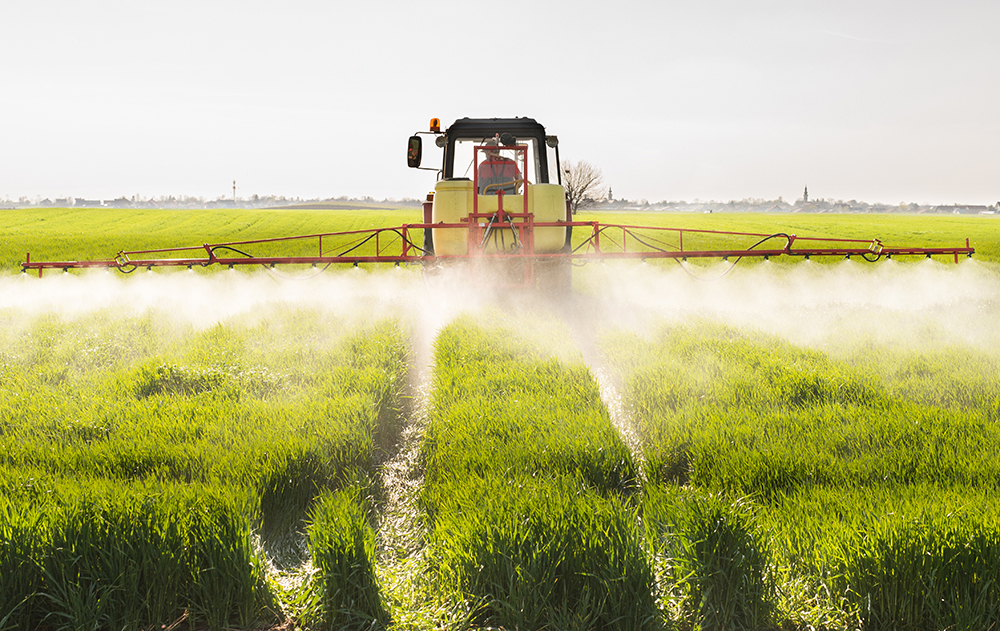
Azole fungicides are used primarily on wheat, corn, and soybeans.

In the 1950s and 1960s, rapidly rising use of antibiotics to promote growth of farm animals triggered mutations leading to resistant bacteria that have found ways to jump into the human population.

For most of the last one-half century, over 7 pounds of antibiotics have been given to farm animals for every 1 pound administered to people. Pigs, chickens, and beef cattle have been an important, and perhaps the primary well from which new antibiotic resistant genes have emerged.

In the 1970s and 1980s, insecticides and herbicides took over primary insect and weed control duty on most American farmers. The better a particular pesticide worked, the more farmers came to rely on it. But just as in the case with antibiotics on the farm, excessive reliance triggered the emergence and spread of resistant strains of many economically damaging pests.

And so, no one should be surprised that the rapidly rising use of triazole fungicides by farmers over the last decade is now contributing to the emergence and spread of fungal pathogens that cause human disease. But not just any run-of-the-mill fungal pathogen.

A new paper by a team of scientists from the Centers for Disease Control (CDC) and US Geological Survey (USGS), “Trends in Agricultural Triazole Fungicide Use in the United States, 1992–2016 and Possible Implications for Antifungal-Resistant Fungi in Human Disease,” tracks the rising frequency in phenotypes of the fungus A. fumigatus that are resistant to triazole drugs (Toda et al., 2021).

A. fumigatus can lodge in and attack the lungs. It is the leading cause of invasive mold infections, especially in people with weakened immune systems. Death rates range between 25% and 59%, but average 25% higher when a patient is infected with triazole-resistant A. fumigatus.

The CDC team points out that some A. fumigatus strains carry resistance markers that have been associated with environmental fungicide use, rather than previous patient exposure to antifungal, triazole drugs.

Key Findings

This fungicide research was led by a team from CDC with support from USGS.

CDC analyzed fungicide use data from the USGS and found that from 2006–2016, triazole use in agriculture more than quadrupled (up 434%) to 2,880 metric tons in just a decade. Since 2016, triazole use has risen another 15%. Worldwide, triazoles account for about one-quarter of total fungicide use in agriculture.

Wheat, corn, soybeans, and other crops in the Midwest and Southeast accounted for most of the increase. Until about a decade ago, almost no corn acres were sprayed with any fungicide. In 2021 over 30% of the national crop will likely be treated. A triazole fungicide will be the product of choice for about one-third of these treatments.

HHRA has prepared two tables with national data on the use of 13 triazole fungicides from 1991 through 2019. The data were retrieved from HHRA’s Pesticide Use Data System (PUDS).

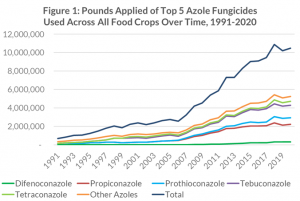
Access here a table tracking changes in pounds applied of the 5 mostly heavily used triazoles, other triazoles, and all triazoles. Figure 1 below tracks the remarkable rise in use since the early 2000s.
Access here a similar table showing the upward trend in acre-treatments with triazole fungicides. Figure 2 presents these data graphically. Access the Excel workbook with these tables and figures here.
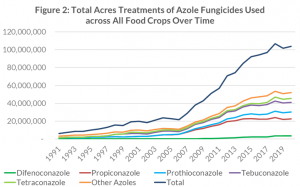
Note in both figures that over the last decade propiconazole plus tebuconazole have accounted for 58% to 75% of the total pounds and acre-treatments made with all triazole fungicides. These two fungicides are among those most structurally similar to the triazole medications widely used to treat A. fumigatus infections.

The CDC team stresses the need to conduct more intensive monitoring of A. fumigatus populations to track the spread of triazole resistant phenotypes. They call for more focused research on what is driving the steep increase in triazole fungicide use on some crops. Since the early 1990s, the pounds of triazole fungicides applied has risen 15-fold. Over 50 million acre-treatments were made with a triazole in 2019, or close to 15% of all harvested cropland in the US.

What is Driving the Rapid Rise in Triazole Fungicide Use?

In short, unhealthy soil and sick plants.

Over the last 50 years farmers have intensified crop production in multiple ways.

The number of corn, soybean, wheat, and cotton seeds planted per acre has at least tripled, and on some farms seeding rates have gone up four-fold. This means plant root systems now overlap and share the same soil. A soil-borne pathogen infecting one plant can infect another without moving.

With today’s high seeding rates, about 35,000 corn plants per acre are separated by only inches, instead of about a foot as in the past. When the wind blows, plants rub against each other, causing abrasions through which fungal spores and bacteria can enter plants. Once in the door, disease can often flourish.

To obtain optimal yields of corn, farmers must apply 150-250 pounds of nitrogen (N) fertilizer. As seeding rates rise, the amount of N needed per bushel rises and N-use efficiency falls.

The spike in soil N levels following fertilizer applications triggers explosions in the populations of certain microorganisms and crashes in the population of others. This cycle degrades soil health over time. The absence of healthy, diverse soil microbial communities opens the door to opportunistic pathogens and soil-borne insects.

Slipping soil health increases pest pressure. Incrementally greater pest pressure triggers more pesticide use. More chemicals cause further damage to soil ecosystems, leading to new pests and more problems. It’s a vicious circle that a growing number of farmers are now struggling to severe.

Most of the corn, soybeans, and cotton grown in the US is planted with seeds genetically engineered (GE) to express multiple transgenes conferring resistance to herbicides. In the case of corn and cotton, GE plants also produce Bt endotoxins to combat sucking, chewing insects. Most corn and cotton varieties express two or three Bt endotoxins, and SmartStax corn produces six and is resistant to three herbicides.

These GE plants have multiple genetic elements added to them designed to turn on these added traits at the right time, in the right place, and hopefully turn them off when not needed. The combined effect of these novel genes in GE cultivars can disrupt, delay, overamp, or block a plant’s normal response to biotic and abiotic stress, sometimes leading to new plant health problems.

This new CDC paper confirms that farmers, the pesticide industry, scientists, and physicians have a new problem to worry about. Like many others, this new problem is grounded in plant and soil health and caused by the practices, technologies, and systems farmers have relied on to drive crop yields upward.

Source:

Toda, Mitsuru, Beer, Karlyn D., Kuivila, Kathryn M., Chiller, Tom M., & Jackson, Brendan R.; “Trends in Agricultural Triazole Fungicide Use in the United States, 1992–2016 and Possible Implications for Antifungal-Resistant Fungi in Human Disease;” Environmental Health Perspectives, 2021, 129(5); DOI: 10.1289/ehp7484.

Back To Top
Search